FREQUENTLY ASKED QUESTIONS
What patients ask us most often.
Photothermoablative Iridoplasty aims to progressively reduce visible pigmentation in the anterior layers of the iris using a laser. The change develops over several sessions and is documented through examinations and clinical photographs. It does not involve placing implants or pigments inside the eye. As a depigmentation process, it does not allow an exact final color to be chosen in advance or the number of sessions needed to reach a final result to be predicted.
This is the term we use for an ophthalmologic laser procedure intended to progressively change the appearance of iris color by reducing visible pigmentation. The laser is applied from outside the eye, and treatment is planned individually.
No. Treatment is slow and progressive. The number of sessions depends on genetics, iris architecture, and each patient’s individual response.
You can find them on our social media channels (Instagram, Facebook, and TikTok), shared by both us and our patients. We will also show you many more examples and their progression during your consultation. However, please keep in mind that every patient responds differently to treatment; the final color and the number of sessions required vary for each patient and cannot be predetermined.
At Iris Color Laser, we use specialized ophthalmic technology within our own clinical protocol for progressive iris color change. The methodology, equipment configuration, and application criteria are part of our intellectual property. Each treatment is performed exclusively by certified ophthalmologists and is personalized after an individual medical evaluation.
Because we need to stay in close contact with all our patients, WhatsApp is currently the only communication channel used by all our clinics. If you would like to schedule an appointment, please download the app, even if only temporarily while undergoing treatment, so that we can communicate with you more easily.
Topical anesthetic drops and eye lubrication are applied before each session. The procedure is generally well tolerated and not painful, although it can be uncomfortable. The experience may vary from person to person depending on pain threshold and other factors. Preparation beforehand is intended to make the session as comfortable as possible. It is an entirely outpatient procedure.
Candidacy is determined through an individual, in-person evaluation that includes your medical history, an ophthalmologic examination, and additional eye studies. Sending photographs, videos, diagnostic studies, and/or ophthalmologic evaluations does not confirm candidacy.
Laser application usually takes approximately 3 to 5 minutes per eye. However, the session is only one part of the evaluation performed at each visit. Allow additional time for the examination, preparation, instructions, patient cooperation, and any assessment the ophthalmologist needs to perform that day. The total time at the clinic is usually about one hour per visit.
Treatment may be personalized, and in certain situations specific areas of the iris may be preserved. This goal must be discussed before treatment so the ophthalmologist can determine whether it is technically reasonable and compatible with a safe treatment plan.
The area near the pupillary margin requires special caution. At Iris Color Laser, a small safety margin around the pupil is always left untreated. This allows us to maintain safety without reducing effectiveness. However, treatment limits are determined by the ophthalmologist according to the anatomy, treatment plan, and safety considerations for each case.
An interest in changing eye color for cosmetic reasons alone does not establish whether an eye meets the appropriate conditions to proceed. The evaluation is intended to identify relevant findings and establish realistic expectations.
Yes. Treatment can be planned for one eye when the goal is a difference in color between the eyes, or heterochromia. An evaluation is still required to determine candidacy and establish realistic expectations.
The simplest nonpermanent alternative is properly fitted colored contact lenses used with appropriate hygiene measures. If you are comparing options, discuss this during your evaluation to understand the differences, limitations, and risks.
The usual Iris Color Laser protocol consists of two sessions on two consecutive days, followed by a minimum interval of 30 days before another pair of sessions. Based on Iris Color Laser’s internal experience, we use this schedule to seek the best possible progression in the shortest time and with the fewest reasonable sessions for each patient. It may be modified if the ophthalmologist determines that your case requires a different pace.
This is the schedule Iris Color Laser usually recommends because it is the protocol that has shown the greatest effectiveness with fewer sessions. However, the plan can be individualized. If you plan to have only one session or would like to try other options, discuss this before scheduling so the team can explain how it may interfere with or change the pace of the process.
No. Initial coordination can take place remotely, but final candidacy depends on the medical evaluation and the clinical requirements established by Iris Color Laser during the in-person consultation.
Yes, it is possible. However, having only one session at each visit usually produces a more limited change in a treatment designed to be progressive. It is unlikely to provide an improvement or greater progress toward the final result compared with the recommended protocol of two consecutive sessions. In our experience, having only one session per month may ultimately require more sessions to reach the result.
Remember that Iris Color Laser is a progressive depigmentation treatment. Each patient responds differently, and the exact number of sessions needed cannot be predicted before starting or during the process. In Iris Color Laser’s experience, many patients may show visible changes around 8 to 12 sessions, but some need fewer sessions and others need more. Genetics, iris architecture, the amount and distribution of melanin, and individual response influence each patient’s progression, including both the final number of sessions and the final color achieved. We have experience and a comprehensive protocol of instructions designed to achieve results in as few sessions as possible with the greatest possible safety. This will be explained on the day of your evaluation.
Iris Color Laser is a progressive iris depigmentation treatment. Changes occur gradually, and each patient needs a different number of sessions. For this reason, there are no “complete treatment” packages; we provide treatment as individual sessions, since some patients need fewer sessions and others need more. One of our goals at Iris Color Laser is to achieve the best result in as few sessions as possible. Over the years, we have achieved this through our treatment protocol and the recommendations for optimizing the process that you will receive after treatment.
Treatment is progressive. In Iris Color Laser’s experience, visible changes tend to become more apparent around 8 to 12 sessions on average, although they may appear before or after this range. These numbers are for guidance and do not guarantee a timeframe or final result. Each patient responds differently, and it is not possible to predict when an individual will begin to notice changes.
The usual Iris Color Laser protocol establishes a minimum 30-day interval after a pair of consecutive sessions before the next pair begins. The ophthalmologist may extend that interval based on the clinical response.
Yes. Individual sessions may continue at another Iris Color Laser location, subject to availability and review of the medical record. If you purchased a package, it must be completed at the clinic where it was purchased because packages are not transferable between locations.
No. The procedure progressively reduces pigmentation, and the final appearance depends on the characteristics of each iris. Genetics, architecture, the amount and distribution of melanin, initial color, and individual response influence the tone observed during treatment.
No. Each iris responds differently, depending on genetics, pigment distribution, iris pattern, and the patient’s response to treatment. Photographs shown as examples from other patients illustrate possible patterns of progression, but they cannot predict your final color or the number of sessions you will need.
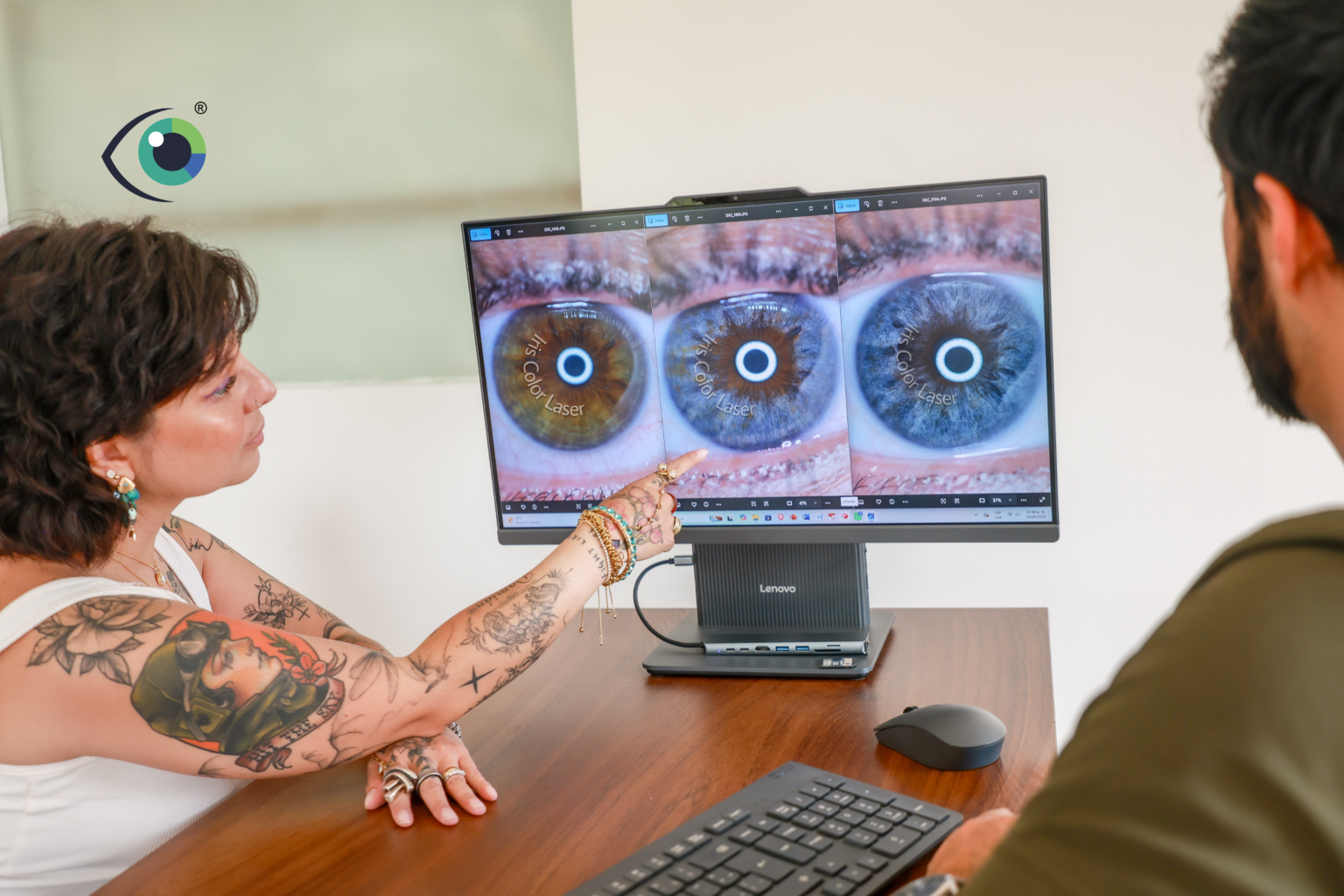
A clinical photograph of the iris is taken at every visit under comparable visual conditions. We use these serial iris photographs to objectively track progress after each pair of sessions for all our patients. Every patient receives their photographs at each visit so they can follow their progress with our team.
You may send them, and we will receive them. However, a photograph or video cannot properly assess eye health, establish a precise diagnosis and/or pigmentation grade, or confirm or rule out candidacy. Unfortunately, sending them will not allow us to answer those questions. An in-person ophthalmologic evaluation and the additional eye studies we request are necessary.
The usual process includes three steps: schedule your appointments with your chosen clinic, have the requested ophthalmic studies performed on both eyes, and attend an in-person evaluation. The ophthalmologist interprets the studies, examines your eyes, and documents the iris with clinical photographs. If you are a candidate, the first session may take place that same day and the second the following day, according to the usual Iris Color Laser protocol.
The Iris Color Laser protocol requires four specialized studies of both eyes that examine deeper eye structures, such as the cornea, optic nerve, and retina, in detail. They complement the in-person ophthalmologic examination and are interpreted by the ophthalmologists during your consultation. These studies must be performed at an independent clinic before your initial evaluation appointment. When you schedule with us, our assistant can help arrange the appointment for these studies with the required specifications. The team may request additional studies if your evaluation requires them.
They may be accepted if complete, if they match the requested studies exactly, are less than six months old, and you have not undergone additional sessions at another clinic since they were obtained. Send them through WhatsApp to your selected clinic before scheduling so the team can confirm whether they can be used.
As part of its internal follow-up protocol, Iris Color Laser recommends repeating some of the diagnostic studies approximately every 12 sessions. The ophthalmologist may recommend other studies or a different frequency depending on your individual case.
You may request a new evaluation. Tell us how many sessions you had, the date of your most recent session, and any relevant history. The Iris Color Laser protocol requires at least 30 days after the last session and new diagnostic studies for a complete evaluation before deciding whether treatment can continue.
Request your records from the previous clinic when possible. Whether or not they can be recovered, Iris Color Laser requires new studies to reassess the current condition of your eyes before deciding whether continuing treatment is appropriate.
Contact lens use does not by itself exclude treatment. For preliminary studies and the evaluation, the protocol requires discontinuing them for one week to reduce the possibility of affecting certain measurements. During treatment, follow the ophthalmologist’s instructions about when to remove them and when use may resume.
Yes, it is usually possible. Previous refractive surgery does not automatically exclude you from treatment. The Iris Color Laser protocol generally requires waiting at least three months after surgery before starting treatment, as well as obtaining current diagnostic studies and undergoing a complete ophthalmologic evaluation to determine whether you are a candidate.
The Iris Color Laser protocol recommends waiting at least one month after rhinoplasty before undergoing treatment. If your surgeon recommended a longer interval or there are complications related to your nose surgery, that recommendation takes priority and should be discussed with your surgeon and during your evaluation with us.
Under the Iris Color Laser protocol, patients under 18 and those with known glaucoma, ocular hypertension, or acute or chronic intraocular inflammation are not candidates. People with autoimmune or systemic inflammatory diseases, such as lupus or rheumatoid arthritis, or uncontrolled systemic and/or inflammatory diseases may also be excluded. Even unrealistic expectations may prevent treatment. An individual evaluation is essential.
No. No eye procedure should be presented as risk-free. Temporary light sensitivity, dry eyes, eye irritation, and/or blurred vision may occur after a session. The medical literature has also described more significant complications following cosmetic laser iris depigmentation procedures. Although uncommon, these must be considered as with any ophthalmic laser procedure, making patient selection and follow-up essential. You can review the risks in the Candidates and Safety section.
Light sensitivity, a feeling of dry eyes, irritation, and/or mildly blurred vision may commonly occur in the hours after sessions. These symptoms are usually mild and temporary, lasting a few hours. Their intensity and duration vary from patient to patient, but they are generally well tolerated.
Use the eye drops exactly as prescribed. On the day of your session, we recommend bringing sunglasses, resting your eyes—preferably by taking a nap—and not driving when you leave. During the first three days, the Iris Color Laser protocol recommends avoiding strenuous exercise and alcoholic beverages. Always follow the specific instructions you receive during your consultation.
Medication is not the same for everyone. Your ophthalmologist will prescribe the specific drops, dosage, and duration of treatment based on your eyes’ response. Do not substitute, discontinue, or extend the use of medications based on recommendations from other patients or information found online without consulting your doctor. For your convenience, you can purchase the drops from us or at any pharmacy with your prescription.
.
Because treatment is performed on an eye structure called the iris. Before considering the cosmetic goal, eye health must be evaluated, risk factors identified, and a decision made about whether you meet the conditions to be a candidate for treatment.
Yes. You may begin contact from any country and coordinate through WhatsApp with your selected clinic. Final candidacy, however, requires complete diagnostic studies and an in-person ophthalmologic evaluation.
We do not recommend doing so. Please first confirm appointment availability and testing requirements with your chosen location. For traveling patients, it is best to plan well in advance and avoid making non-changeable reservations until your schedule is confirmed. Please remember that, out of respect for other patients’ time, we cannot see patients without a prior appointment.
Yes, provided they match the requested studies exactly, are current, and the clinic confirms that they can be used. Send them through WhatsApp before your visit so the team can check that they are complete. Acceptance of the studies does not confirm candidacy.
Appointments are scheduled only through WhatsApp to streamline communication. Request the scheduling link from your preferred clinic through WhatsApp to view available dates and times. Iris Color Laser operates by appointment; confirm your appointment before arranging travel.
Iris Color Laser currently has locations in Guadalajara, Mexico City, and Lima. Visit the Contact section for the current address, hours, WhatsApp number, and location of each clinic.
In Guadalajara and Mexico City, cash in Mexican pesos and bank credit or debit cards are accepted. In Lima, cash in US dollars or Peruvian soles is accepted according to the clinic’s current exchange-rate policy, as well as bank cards. Confirm any payment details with the clinic before your appointment.
Iris Color Laser sessions are performed by certified ophthalmologists. The medical evaluation and treatment plan are managed by the ophthalmology team at the clinic providing your care. Treatment, parameters, and protocols are standardized across all three locations. You will receive the same procedure regardless of the clinic you visit and/or the ophthalmologist who treats you.
Iris Color Laser began providing this treatment in 2019. However, cosmetic laser iris color change has been described and used at other centers since 2011.
Contact a clinic
Didn’t find your answer?
Contacting the clinic and having an in-person ophthalmologic evaluation can help answer questions specific to your case.